
2 min drill


2 Minute Drill Online: A Coach's Chair, Graded by a Machine
2 Minute Drill hands you the closing minutes of a real NFL game and asks you to call the plays. You never control a quarterback or throw a ball. You pick a call from a menu, the game plays a snap drawn from recorded seasons, and then it tells you what that call did to your team's win probability.
The score is not whether the drive worked. It is how close your decision came to the best decision available in that moment, which is a distinction the game takes seriously enough to grade before the ball is even snapped.
That makes this less a football game than a judging engine with a stadium around it.
Why a Good Call Can Still End in a Punt
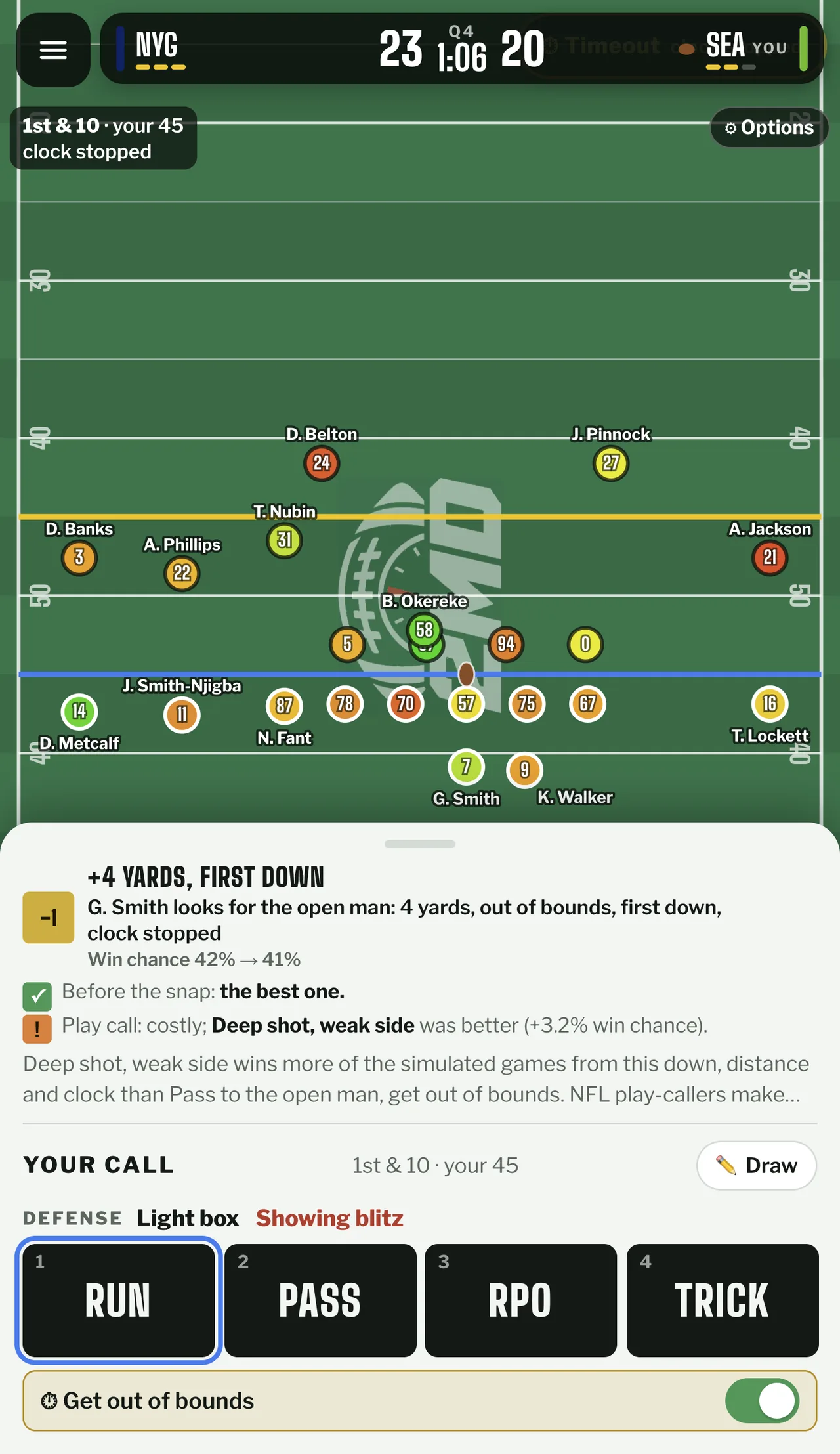
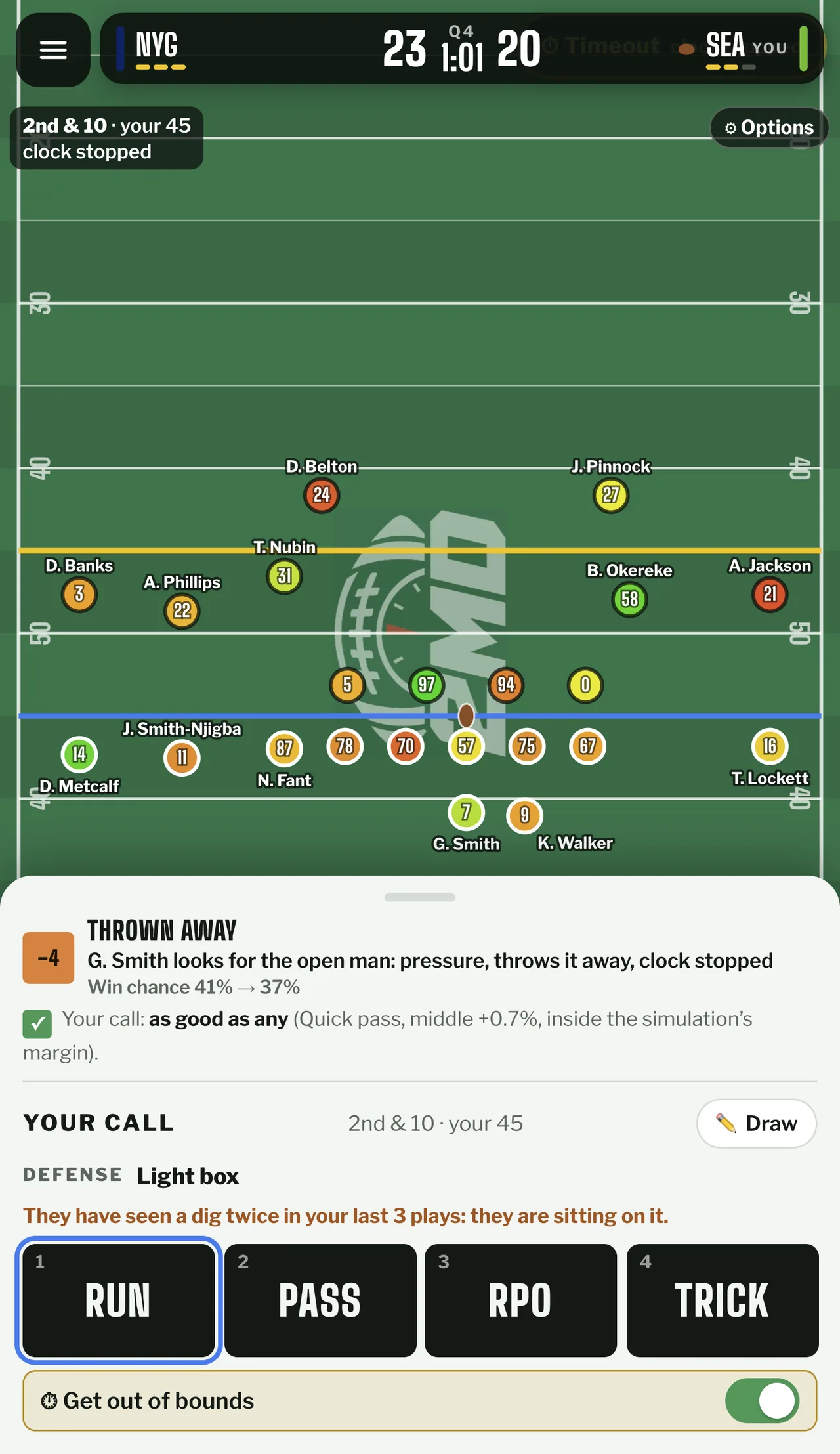
The grade is fixed before the snap. For the situation in front of you, the game simulates the rest of the game for every call on the menu, hundreds to thousands of times each, and compares your choice with the best of them. Green means you matched the best call or came within half a percentage point of it, yellow is within two, orange within five, and red is anything worse. The large number after the snap is the change in win probability your call produced.
Because the comparison happens first, a completed pass can be graded red and an incompletion can be graded green. That is the design working, not a scoring bug: a bad decision that happened to work is still a bad decision, and the game says so on the same screen that shows the good outcome.
The separation is what lets the game teach anything. Most football games reward the result, which trains you to repeat whatever worked once. This one rewards the process, so the useful feedback is the gap between your call and the best call, not the yardage. Read only the result banner and you are reading the least informative part of the screen.
The Ceiling: 6,000 Simulated Coaches and a 0-to-100 Line
At the end of a Daily run your decisions are scored against 6,000 simulated coaches. Each calls plays at a frequency modelled on how real coaches behave in that situation, with a spread of competence, so the result lands on a 0 to 100 line. Calling the way the league average calls puts you near 50. Winning the game is worth roughly 15 to 20 points on the same calls, and reaching 90 takes accuracy rather than luck.
That calibration is the most useful number in the game, because it says what an average decision looks like. A score in the fifties is not a failure; it is the middle of the distribution by construction. A score in the seventies is a genuinely good run. The top of the range is reachable but narrow, and the last stretch of it is made of calls nobody enjoys making: punting when the crowd wants a throw, or taking the checkdown on third and long.
There is a second ceiling that is easier to miss. The grade bands are fixed, but the situations are not equally forgiving. A two-minute drill with three timeouts left and one with none are different puzzles, and the same call can be green in one and orange in the other. Chasing a percentile means caring about which situations you were handed, as well as how you called them.
Number Keys Are a Shortcut, Not a Control Scheme
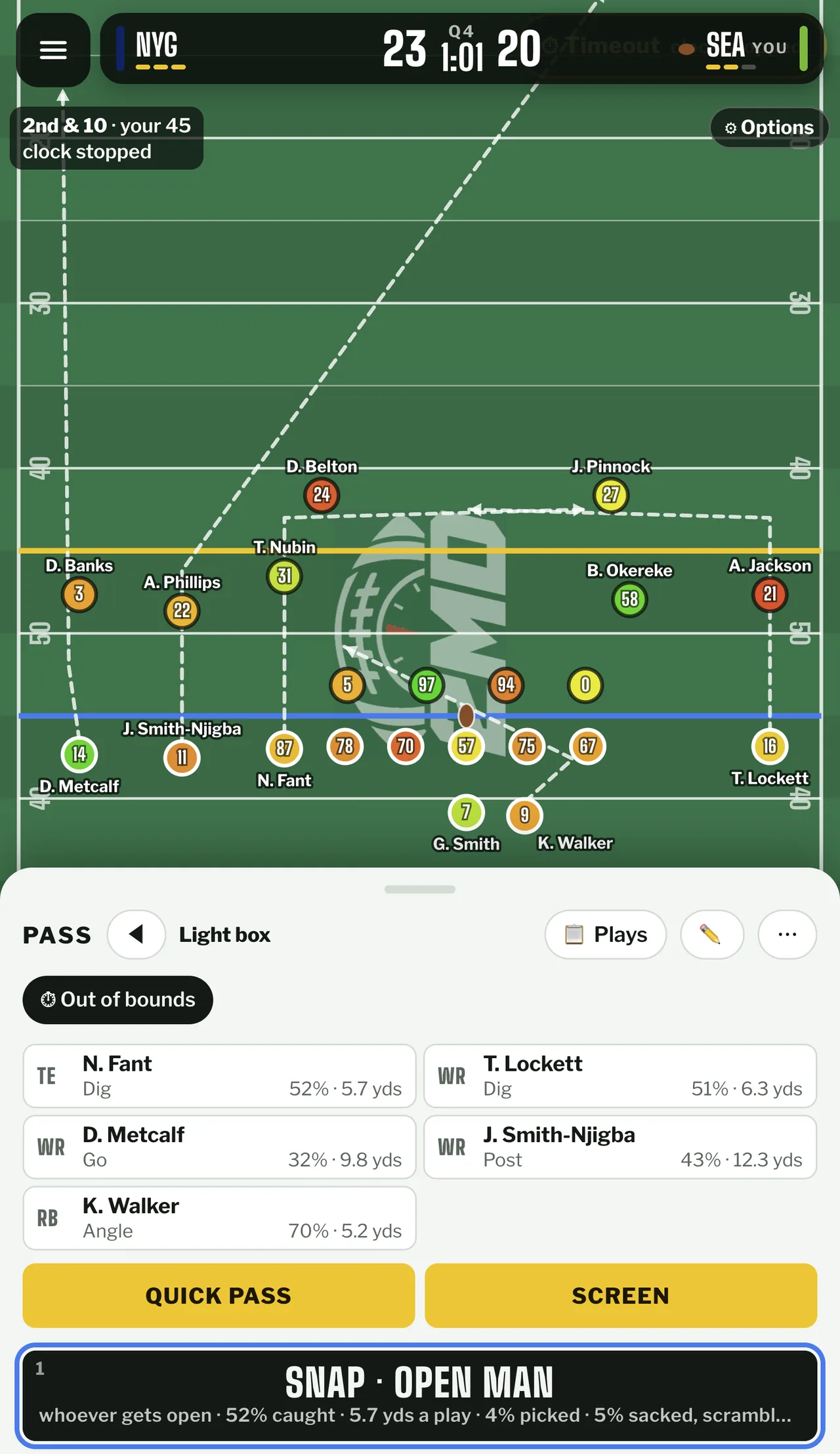
Everything is clicked or tapped: pick a play family, pick the play, pick a receiver, then press Snap. Number keys one through nine fire the numbered buttons on screen, so a keyboard can drive the whole menu, and Space skips the snap animation. Tab and Enter move between buttons and confirm. There is no movement input of any kind, because there is nobody to move.
Reading that as a control scheme would be a mistake. The keyboard buys speed, and speed only matters in Versus, where each call has a thirty second limit and two timeouts in a row lose the game. In Daily and Survivor the clock belongs to the game, not to you, so a slow careful call costs nothing. Use the mouse, read the situation, and save the number keys for the mode that punishes hesitation.
Before the snap there are other levers: changing the personnel grouping, redrawing a receiver's route, and in Pro drawing a freehand route that resolves to the nearest real route at the depth you drew. They turn a menu into a plan, and they are easy to skip because the default call already looks reasonable.
Three Tempos and Only One Fits the Clock
Clock management sits on the same menu as the play call, in three settings: no huddle at roughly 17 seconds, huddle at roughly 34, and milk it at roughly 38. The game clock runs on NFL rules, stopping on incomplete passes, on out-of-bounds plays inside the last two minutes of a half and the last five of the game, on timeouts, at the two-minute warning and after scores.
Because tempo and play are chosen together, they are one decision rather than two. A pass stopped by an incompletion saves clock; a run that stays in bounds burns around forty seconds and may be exactly right when you are ahead. A deep shot on milk it is close to a contradiction, and the grading usually says so.
The mistake to expect from a new player is treating tempo as a cosmetic setting. It is the second half of every call, and in a two-minute drill it is often the difference between a green grade and a red one on identical play selection.
Screenshots From the Fourth Quarter at 1:06
Which Mode Actually Tests Your Ceiling
Daily gives everyone the same situation once a day and one attempt at it, which makes it a test of a single decision. Survivor chains random fourth quarters and a loss ends the run, so it measures consistency across situations you did not choose. Versus is college overtime against another player, starting at the opponent's 25 with no clock, two-point conversions required from the second overtime and a single two-point attempt from the third, thirty seconds per call and two timeouts in a row ending it.
Pro is less a mode than a shelf: a one-time 4.99 dollars for historical battles, playoff replays, past dailies and the freehand route tool. It does not change the grading, which is worth knowing before buying. What it adds is more situations to be graded on.
If the goal is to find your ceiling, Survivor is the honest test and Daily is the comparable one. Versus tests speed under a clock that has nothing to do with football, which is a different skill and a fair one, just not the same one.
2 Minute Drill FAQ: Cost, Data and the NFL Question
Is 2 Minute Drill free?
Daily, Survivor and Versus are free. Pro is a one-time 4.99 dollars for the historical battles, past dailies and the freehand route tool.
Do I need an account?
No. The game opens and plays without one. The sign-in in the corner is for leaderboards and syncing across devices.
Is the game data real?
The scores, clock, down, distance and the 22 players on the field come from real games, and each snap is drawn from recorded plays. The grades are model estimates, not official or team-issued analysis.
What are the controls?
Click or tap to choose, then press Snap. Number keys 1 to 9 fire the numbered buttons, Space skips the snap animation, and Tab plus Enter move and confirm. There are no movement keys.
Does it work on a phone?
Yes. The page detects touch and renders a touch layout, and it can be installed to the home screen. The first visit pulls several megabytes of play data, so give it a moment on mobile networks.
Is it affiliated with the NFL?
No. The footer says it is an independent fan project with no affiliation, licence or sponsorship from the league, its teams, its players or the players' union.
Games Like 2 Minute Drill With a Harsher Clock
The thing worth copying from 2 Minute Drill is the reset, not the sport: one fixed problem a day, one attempt, a score you can only compare afterwards. Noillirk runs that shape as a quiz, and the two racing games below give you the same short-attempt rhythm with a physics body instead of a play sheet.

