
noomiclone


Noomiclone Online: A Body You Can Only Fold, Never Steer
Noomiclone puts a jointed body on a bar and gives you four keys that change its shape. There is no run button, no steering and no aim reticle. Everything that happens after you let go is decided by how the body was folded at the instant of release, which makes the browser build less a platformer than a one-body physics problem you can retry forever.
The developer's own description makes the same point from the other side: momentum and rotation carry through every move, so no two attempts land the same way. The inputs are postures rather than directions. Arch, tuck, let go, reset, and the swing you build between them is the game.
One bar line, one scene, one body. The ceiling is entirely in the timing.
Noomiclone Controls: Four Keys That Change Posture, Not Position
The browser player prints the scheme along the bottom of the frame: the left arrow arches the back, space tucks, the up arrow lets go of the bar and R resets the scene. The itch listing spells out the same four bindings in words, so the scheme is not something you have to reverse engineer from a tutorial video.
What the keys do not do is the interesting part. None of them pushes the body sideways, none of them walks it along the floor and none of them aims. A swing is the only way to travel, and a release is the only way to leave the bar. That is why the game reads as a physics toy first: your hands are negotiating with a pendulum rather than driving a character.
Four large on-screen buttons carry the same names, so a mouse or a finger can trigger arch, tuck, let go and reset without a keyboard. I did not test that layout on a phone, so how the buttons sit under a thumb stays an open question.
The store listing for the phone game names nine actions, among them Pike, Layout, Twist, Flash Kick and Bar Regrab. Four of those appear in the browser build as buttons, and Twist and Grab do not appear anywhere in its scene objects or interface strings. Arch, tuck, let go and reset are the entire vocabulary here. If you arrived expecting the full move set, this build is the short list.
Of the two posture keys, tuck does more work. Pulling the mass in toward the hips is the pose that speeds up rotation on the way to a release, and arch is the one that slows a spin you no longer want. That reading comes from how a real body behaves on a bar, not from anything the game prints on screen.
How Much Energy a Swing Can Hold Before Release
A swing is a pump, and the two posture keys are its valves. A body gains height by shifting its mass at one point in the arc and gives it back by shifting at another, and that is the pattern behind every bar swing, real or simulated. Arch on the way down and tuck on the way up is the rhythm the four keys invite, and it is the first thing I would test on an attempt that keeps dying short of the next bar.
Nothing on screen measures the charge. The build shows the body, the bar, the red floor and the sky, and the only number in the frame is the regrab counter. The readout for a good swing is therefore geometric: where the hips sit relative to the bar at the top of each arc, and how much of the arc the body covers before it starts falling. Treat that as inference. The game never states the rule, and a rigid body with four pose keys is consistent with it.
Every swing also has a ceiling of its own. Past a certain arc the body stops adding height, and the gain left on the table comes from the angle at which you leave rather than from another pump. Knowing when to stop pumping is the first skill here, and the four keys make it easy to practise badly: pressing tuck on every arc feels productive and mostly wastes the phase.
The Release Is the Ceiling: Two Ways an Attempt Ends
The build leaves two ways to miss. Leave too early and the body falls short of the next bar with nothing to grab; leave too late and the rotation carries the hands above or behind the bar, where they close on air. Both are timing errors, and neither has a correction built in, because there is no button that presses harder.
What is easy to misread is what the keys can still do in the air. In a rigid body, folding or unfolding changes how fast the body turns, but it does not bend the path of the centre of mass. Arch and tuck after the release can therefore rescue a landing angle and cannot rescue a short throw. Reading a miss as a mid-air mistake sends you to fix the wrong half of the attempt.
Treat the release as final. Everything before it is preparation, and everything after it is decoration.
Why One Counter Beats a Distance Score
A small figure at the top of the frame counts regrabs: the number of times the body has caught a bar after leaving one. It is the only progress number the browser build shows, and it is a stricter measure than distance would be, because a regrab requires that both the release and the catch worked.
Two attempts ending on the same count can be worth very different amounts. Three regrabs built from the same safe release, repeated, are a different skill from three regrabs reached by changing the angle each time. Only the second has touched the ceiling; the first has found a groove.
That is the argument for watching the counter rather than chasing a single lucky catch. A number you can reproduce tells you the method is stable, and a number you cannot reproduce tells you it was luck. In a game with one scene, that distinction is most of what there is to learn.
Screenshots: Rest, Arch and the Dive Between Bars
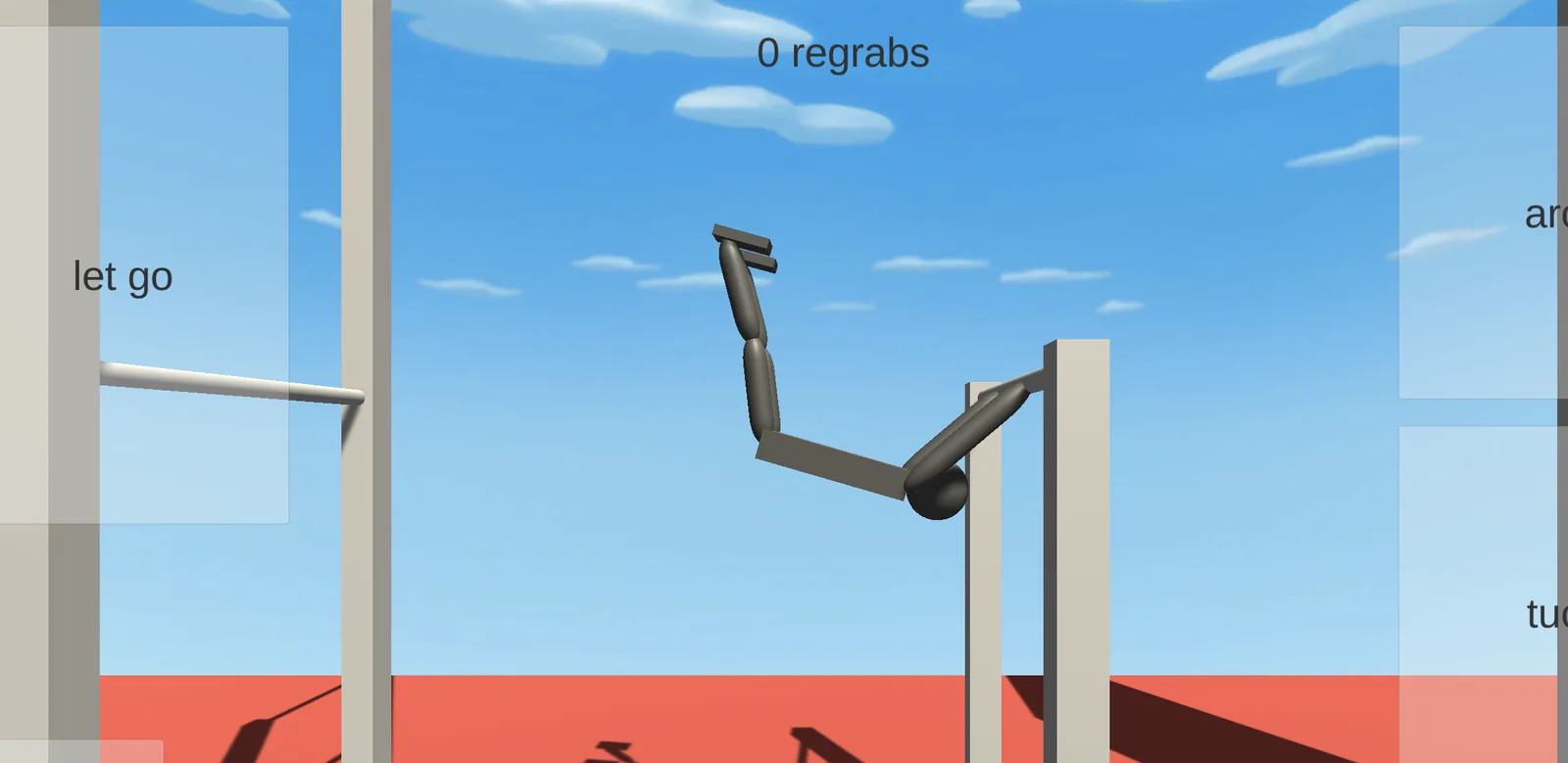
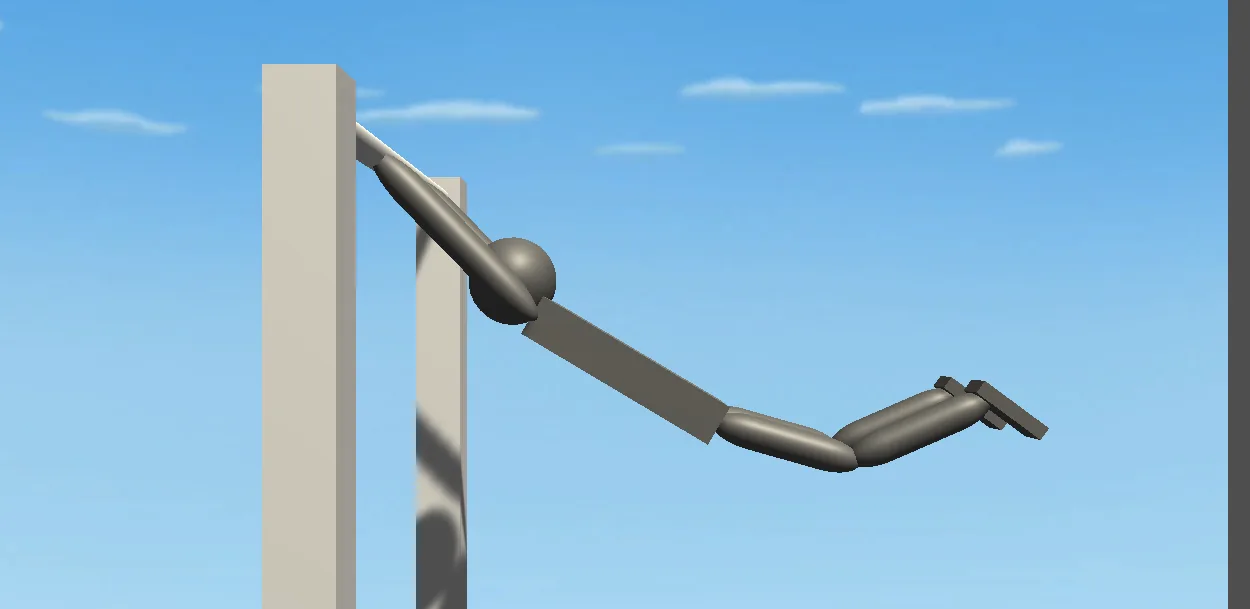
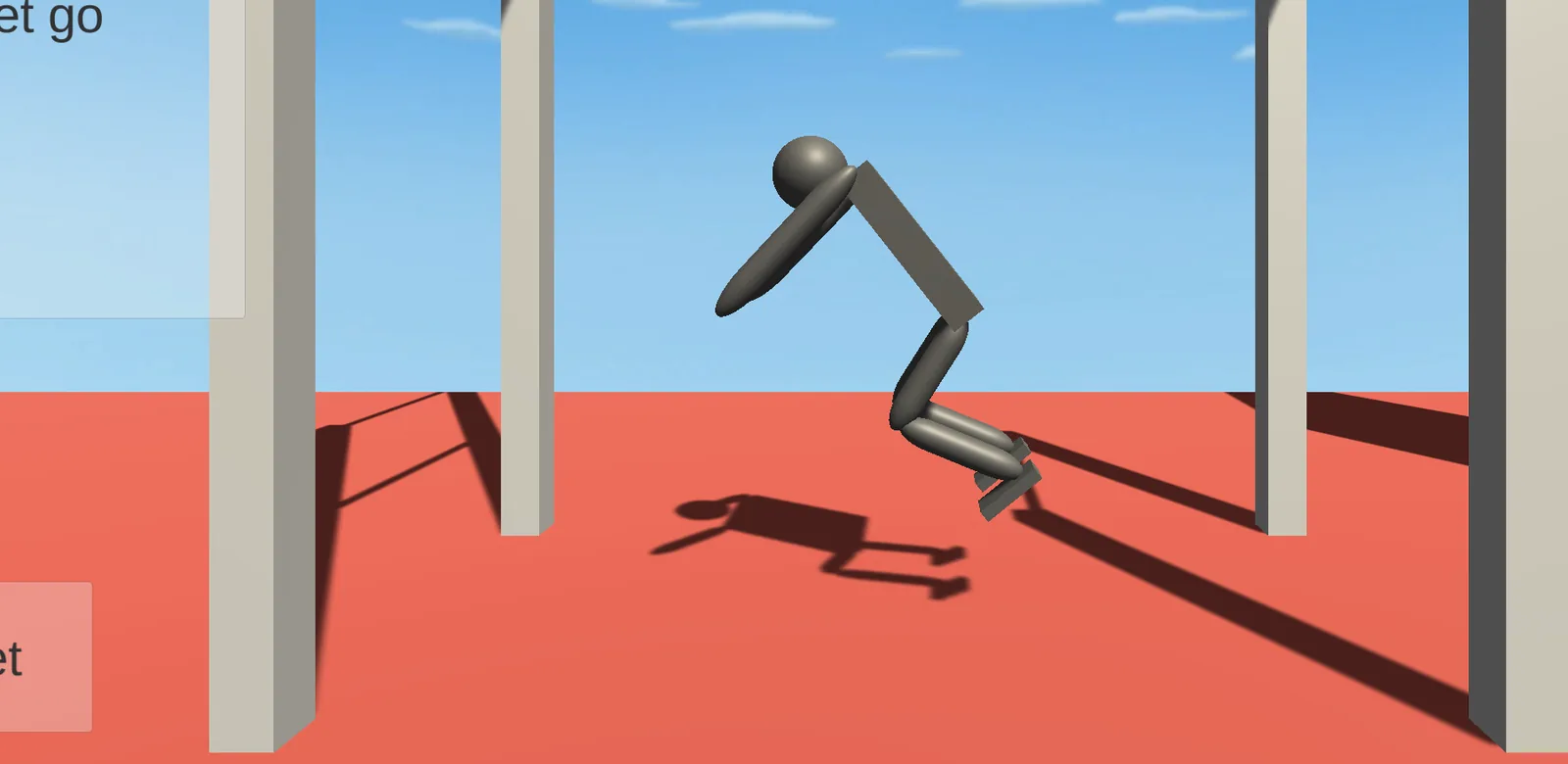
The Build Number Explains the Missing Menus
The browser build reports version 0.9, and the itch page lists the game as in development. That status shows in the player too: a single fixed scene, no map picker, and none of the extra actions the store listing promises.
A scene count is the honest way to describe what you get. There is one bar line, one body and one set of four keys, and every attempt after the first is the same geometry again. Repetition is what makes a physics problem legible, so for a certain kind of player that is the point rather than a limitation.
For anyone who wants progression, the menu that is not there will be the first thing noticed. The itch page's own status says this is a work in progress, and the browser version behaves like one: tight in the loop, thin on content. That is a fair trade for a free build you can open in a tab, and a poor one if you were hoping for the phone game.
Noomiclone FAQ: Keys, Missed Grabs and the Build Number
Is Noomiclone free to play?
Yes. The browser build opens from the developer's player page without an account or a purchase step. The phone releases are free as well and carry ads with in-app purchases.
Do I need to download anything?
No. The game is a Unity WebGL package that runs in the tab, and the build's data and WebAssembly files add up to roughly 20 MB, so the first load is the slow part.
Why can't I choose a map?
The browser build contains one fixed scene and no map menu. The itch page lists the game as in development, and the build reports version 0.9.
What do the four keys actually do?
Left arrow arches the back, space tucks, up arrow lets go of the bar and R resets. They change the body's shape, not its position, so none of them moves you sideways.
Why does the body keep spinning after I let go?
Rotation carries through a release. Folding in the air can change how fast the body turns, but it cannot bend the path of the centre of mass, so the direction of a miss is already set.
Does the browser build include every move from the app?
No. The store listing names nine actions, and only arch, tuck, let go and reset exist as inputs here. Twist and Grab do not appear in the build at all.
Games Like Noomiclone for Studying a Physics Body
Noomiclone is the only ragdoll on this site, so the closest neighbours are games where momentum does the work and your input only nudges it. If what you liked was managing a body rather than steering a vehicle, start with the downhill pair; if you liked the retry loop, the third one has the same one-more-run shape.