
Noillirk


Noillirk Online: Guessing What a Hundred People Would Say
Noillirk is a daily quiz that never asks whether an answer is correct. It asks how many of a hundred people would have said the same thing. You type a reply, the game places it on a board of estimated crowd favourites, and the rank it lands on sets your points. The score is a bet on other people's first instincts, which makes this a strange cousin of a knowledge quiz: knowing more only helps if the crowd knows it too.
Ten questions, thirty seconds each, one Daily run per day. Behind that simple loop sits a scoring model with a fixed ceiling, a tolerance for typos and a second currency called spectators, and the three of them explain almost every decision a run asks you to make.
What follows is how that model behaves at the edges, because the edges are where a run is won.
The 2,500-Point Ceiling and the Third That Sits at the End
A perfect Noillirk run is worth 2,500 points. The arithmetic behind that number is the closest thing the game has to a skill ceiling, and it is worth doing once, because it changes how the ten questions should be played.
An answer's base value comes from its rank on the board: the top answer is worth the most, the next rungs less, and anything off the board least. That base is then multiplied by the question's position. The first two questions count once, the middle ones count double and triple, and the last two count four times each. The tail therefore carries close to a third of the ceiling by itself. Two strong late answers outweigh a flawless start, and a run that fumbles question nine has already lost the top of the range before the final prompt appears.
There is a second currency. Every 25 points sends one of the hundred spectators across to your side, so score and crowd move together and you cannot chase one without the other. That is the cleanest part of the design: a single number to optimise, drawn as little wooden figures walking over to stand on your card.
Most runs will not go near 2,500, and the game is built for that. The target worth aiming at is a run where no single question is wasted, which is a different goal from a lucky first answer and a much better one once the format stops feeling new.
Where the Answer Checker Stops Forgiving You
Acceptance is generous by design. Case, accents and punctuation are ignored, a leading the, a or an is dropped, plurals are read as singular, and common aliases pass, so Lisboa counts for Lisbon. Answers of five characters or more are allowed one slip, whether a missing letter, an extra one, a transposition or a wrong letter, and the result card tells you what it read. Shorter answers must be exact, so Rom will not pass as Rome.
That last clause is worth carrying into play. The tolerance turns short answers into the only category with no margin, and several of the most obvious answers in a category are short. A three-letter answer is a bet that you spelled it the way the answer table did, which is a strange thing to bet a question on when a longer synonym would have been accepted.
Rejection is cheap but not free. A refused answer costs no points and the clock keeps running, so the right move is to try the next candidate immediately; the only thing a rejection spends is seconds. At the end of a question the card offers a Should this count? link that sends the prompt and answer back to the team maintaining the table, and the official note says those reports are counted without identifying information. For a list that can never be complete, that is the sane way to grow it.
One Input Field, Thirty Seconds, Three Exits
The interface gives you a single field and three ways out. Type an answer and press Enter, or click the arrow beside the field; press Pass to give up the question; click the picture to skip the reveal and move on. On a phone the same field picks up the soft keyboard, and the official instructions say it sits above the keyboard rather than behind it.
The clock is thirty seconds per question, with the bar turning solid red for the last ten and a tick for the final five. One detail is easy to miss: switching to another tab pauses the timer, and it resumes when you come back. That makes the clock a limit on attention rather than a hard wall, and it means a distracted run is not automatically a lost one.
Pass deserves more respect than it usually gets. It costs the question's points and nothing else, so passing on a category you cannot read is a smaller loss than a confident wrong answer that eats four seconds of typing. The three exits are not equal, and treating them as equal is the easiest way to leak points.
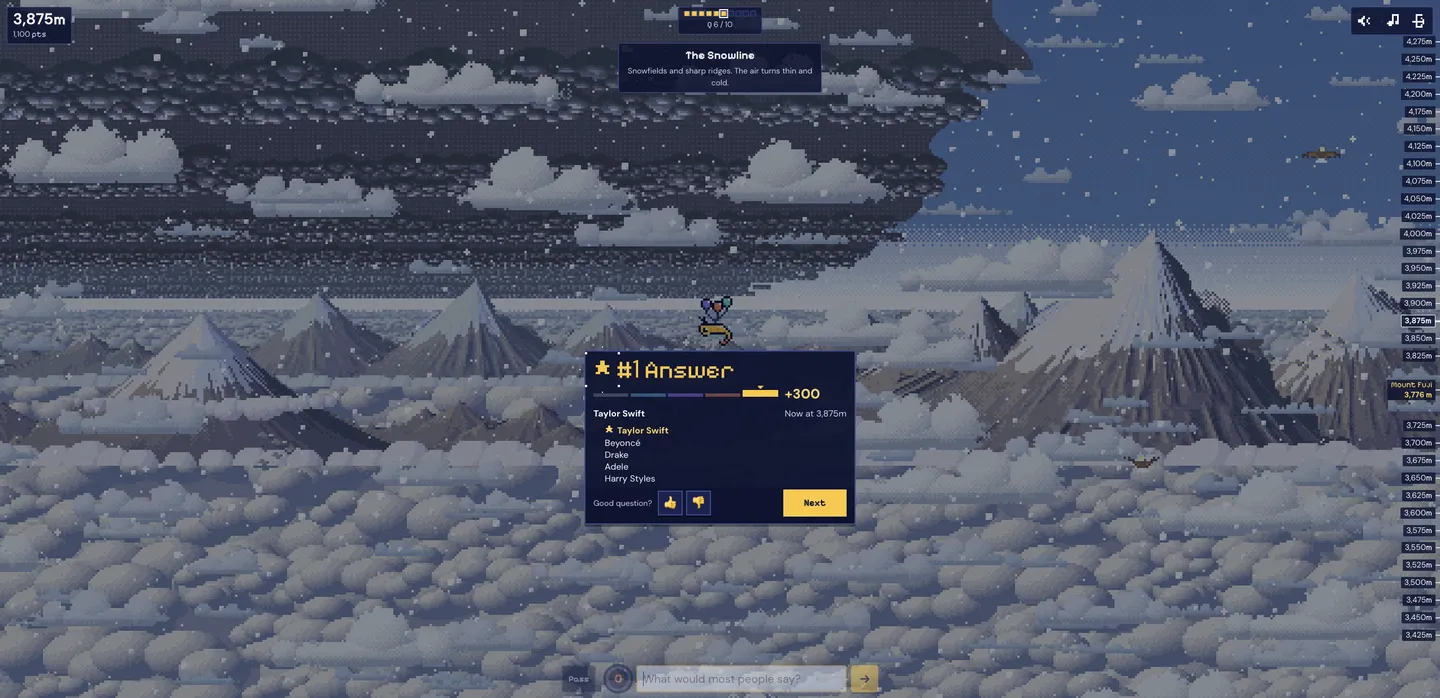
Three Frames From the Climb at 1,800 Metres


Unlimited Is the Lab; Daily Is the Exam
The Daily is one numbered set of ten per day, the same questions for everyone, with a streak that survives only if you finish. Leaving halfway saves your place and the opening card offers to resume, but the streak is tied to completion rather than to starting.
Unlimited uses the same rules and the same pool of questions with the daily limit removed. You can play ten, twenty or an endless run, and the first ten are ordered from easy to hard, where easy means most people give the top answer and hard means the crowd splits. A ten or twenty question set can be replayed from the same seed, which is what makes challenge links work: a friend gets your questions in your order and sees what you answered as they go.
The difference that matters is scarcity. Daily gives one shot and compares you with everyone else that day; Unlimited gives as many shots as you want and never touches the streak. Practising in Unlimited trains the instinct the Daily tests, which is guessing what a hundred strangers would say rather than memorising facts. A player whose Unlimited scores sit far above their Daily scores has a nerves problem, not a knowledge problem.
The Percentile Line Under the Final Score
After a Daily run the summary does more than add up points. It compares you with everyone who has finished that day, in a sentence like more than 72 percent of players today, and it marks the first finisher with a line of their own. Below ten finishers the comparison changes wording, and under ten percent of the field it disappears.
That percentile is the only place the game meets real people. Every board you played against was estimated in advance rather than counted live, which is why the interface labels it that way. The crowd model is a fixed guess about a hundred people; the percentile is the only live number in the loop, and it is the honest read on whether your instincts match the people who actually showed up.
The two numbers can disagree, and the disagreement is informative. A run that scores well against the model but lands mid-pack in the percentile says the questions were easy for everyone that day. The reverse says you found answers the model undervalues. Neither is a bug, and both are more useful than the total on its own.
Noillirk FAQ: Free Play, Lost Progress and the Daily Reset
Is Noillirk free?
Yes. There is no account, no paywall and no subscription, and the Unlimited practice mode is free as well.
Where is my progress saved?
Daily progress, the streak, the nickname and the sound settings live in the browser's local storage. Clearing site data, switching browsers or opening a private window starts you over.
How long does a run take?
Ten questions at thirty seconds plus a reveal each, so about five minutes at the slow end and less if you answer fast.
What happens if I close the tab mid-run?
Your place is kept and the opening card offers to resume at the question you left. The streak only advances when the set is finished.
Why was my answer rejected?
Short answers have to match the table exactly. Longer ones get one slip, but a three- or four-letter answer with a wrong letter will not pass, and a rejection costs time rather than points.
Can I play more than once a day?
Yes, in Unlimited. It draws from the same pool and does not affect the Daily streak or the daily percentile.
Games Like Noillirk if You Want Another Crowd to Read
This site has no second survey game, so the honest matches are games that share Noillirk's shape rather than its subject: a fixed daily set, a single attempt, and a score you can only compare after the fact. The first one below resets every day like Noillirk does; the other two are the retry loop without the crowd.

